From the start, we’ve wanted to use this blog not only to update friends and family on Theo’s journey but also to share our experience in a way that could be beneficial to us and others who have gone through or are preparing to go through something similar. We’ll start here with a quick update.
Theo is currently having his pre-surgical cath procedure performed. He’s an active boy these days (to say the least…), so it took all of our focus and patience to keep him occupied and relatively still within a small room and on an even smaller hospital bed. But we did it and we’ll take all the victories we can get at this point!
The cath procedure gives the doctors an opportunity to take an up-close look into Theo’s heart and surrounding circulation in a way that imaging can’t provide. They want to make sure that among other things internal pressures are normal or close to it, blood is flowing appropriately and his lungs and blood vessels are growing as hoped. The purpose of the interventions Theo’s received to date has been primarily to re-circulate blood flow to and away from his heart so the one ventricle he has can do the job that it takes two of ours to do (it’s a pretty impressive ventricle). The cath procedure gives the doctors the opportunity to see how the new circulation is working.
The next steps will depend on what the doctors find today. If all looks OK, he will most likely undergo the Fontan surgery on Thursday. There are some other alternatives on the other side of a bridge that we’ll cross if and when we get to it, but having the Fontan done on Thursday is the most likely outcome at this point, and recovery would be about 7-10 days. We’ll keep you all updated as we know more.
To wrap with some reflection, we’ve told friends and family that preparing for this procedure has been different for us than it was for the previous procedures. Most of the time we’ve spent at Boston Children’s was when Theo was under six months old. It was of course scary to see our infant son so vulnerable at such a young age, but our relationship with him was different then. The love and care we had for him were limitless but we were new parents getting used to having a child to watch over, and frankly he was primarily just eating, pooping, sleeping and repeating.
From now to then, he’s grown, and our relationship with him has grown, so much that our bond with him is in some ways stronger and in some ways more complicated. Yesterday, when Meaghan was putting him in his car seat, he looked over and said, “Mommy don’t hurt me!” It was adorable – particularly because Meaghan couldn’t hurt a fly – but it was also expressive in a way he couldn’t muster at six months old, and it was reflective of a personality that has taken shape since then. Watching your son getting wheeled away in a hospital bed feels different when the child there is a boy and not a baby – a boy with unique likes, dislikes, strengths, weaknesses and wants and needs that you’ve come to know, love and appreciate. And a boy who doesn’t want to be hurt, but one who will grow stronger in the face of it.
As challenging as the preparation can be, it has pushed Meaghan and me to continue working together and listening to each other as we both process a pretty complex emotional roller coaster. Regardless of what’s in store for our family and what bridges we need to cross, we’re optimistic that that experience alone will better equip us to navigate the path ahead.
As always, thank you for all of your encouragement and support – it truly does mean the world to us.
Theo is done for the day and recovering peacefully with Mickey Mouse and the Mickey Mouse Clubhouse. The takeaway from today is that all is well and things are looking better than expected. We’re so reassured the doctors were able to confirm the development of Theo’s heart and surrounding circulation is right on track, and as long as Theo continues to come out of the anesthesia as expected, we will head back to Rochester tomorrow morning. Quick updates on what the doctors found below.
Blood Flow to the Left Lung
To measure blood flow to the lungs, Theo’s doctors have used a test called a lung scan. Theo’s latest lung scan in July showed lower than normal blood flow to the left lung, and his blood oxygen saturation levels were also a bit low.
We found out that lung scans are not perfect tests, and can at times present misleading information depending on a variety of factors. Fortunately, that turned out to be the case here. Theo’s left pulmonary artery is a good size and there are no obstructions interfering with the blood flow to his left lung.
Glenn Pressure
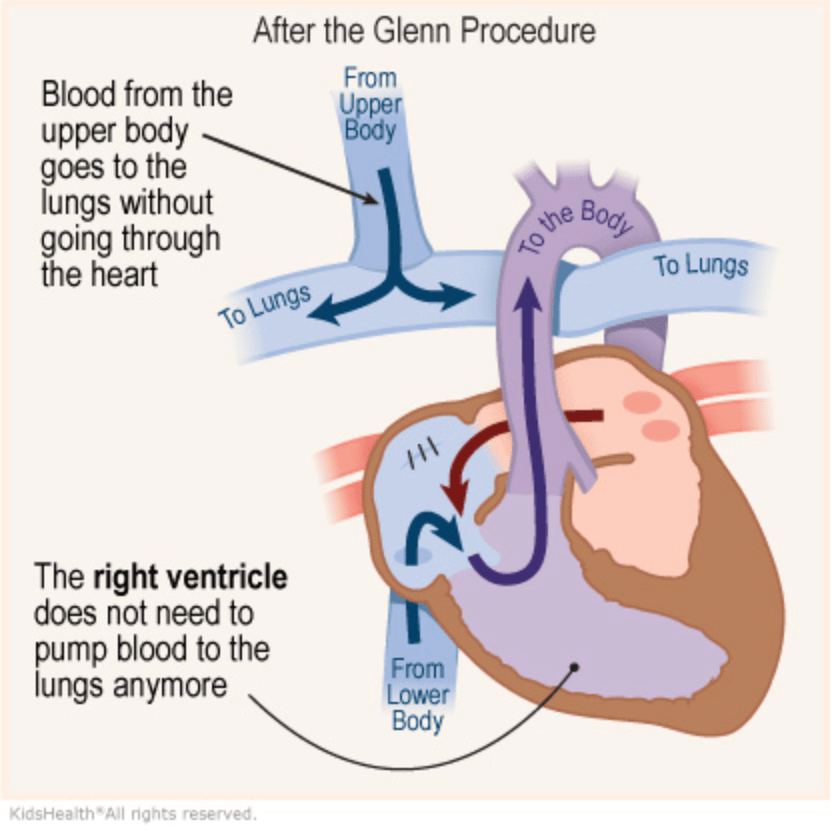
One issue that can come up after the Glenn surgery, which Theo underwent last summer, is the blood pressure in the new circulation can get too high. High pressure following the Glenn can indicate that the body is needing to work too hard to get blood to the lungs, which can cause the lower sats we were seeing. We found the images below from KidsHealth (https://kidshealth.org/en/parents/glenn.html) helpful in understanding Theo’s circulation before and after the Glenn procedure.
The takeaway is that Theo’s Glenn pressure is right where the doctors want it to be. Good blood flow to the left lung and low Glenn pressure are really important because they make Theo a good candidate for the Fontan surgery, which is the last of three interventions that single ventricle children typically undergo. As of now, Theo shouldn’t need any other interventions before having the Fontan done, which will be some time between the ages of 2 and 4.
Ruling out obstructed blood flow to the left lung and high Glenn pressure, Theo’s doctors came to the last suspect in this story for causing his low sats.
Collateral Blood Vessels
Sometimes children with a single ventricle can develop what are called “collateral blood vessels”, which are veins or arteries that are not typically present in children with normal hearts.
In Theo’s case, he had a moderately developed collateral blood vessel that was bringing deoxygenated blood to his heart instead of directly to his lungs for oxygen. This not insignificant amount of deoxygenated blood was then mixing in the heart with the oxygenated blood that came from Theo’s lungs, lowering the overall oxygen level of Theo’s blood and likely accounting for his low sats.
The doctors were able to block the collateral blood vessel this morning, which should now disappear on its own.
Next Steps
If all goes according to plan, the next 18 months or so will be similar to the last 12 — we’ll continue to monitor Theo’s progress and hopefully it’s pretty uneventful until it becomes time to have the Fontan surgery done.
As always, we’re so thankful for all of the thoughts, messages and support, which is helping our little warrior continue fighting strong.




 Two and Three Quarters Full